Bodyweight Workout: The Honest Guide To Getting Stronger At Home
By:Author:Calistway Editorial
Updated on:October 16, 2026

- Does a Bodyweight Workout Actually Work?
- Why This Beats the Harder Alternative
- The Quantity Question: How Much, How Many, How Often
- The Practical Question: How Do You Actually Fit This In?
- Bodyweight vs Weights: The Decision You're Actually Weighing
- The Forbidden Promise, Answered Honestly
- Levers That Change the Result
- How Long Until You See Results?
- Your First Four Weeks
- What Stalls Progress
- Why Calistway Works for This
- Final Thoughts
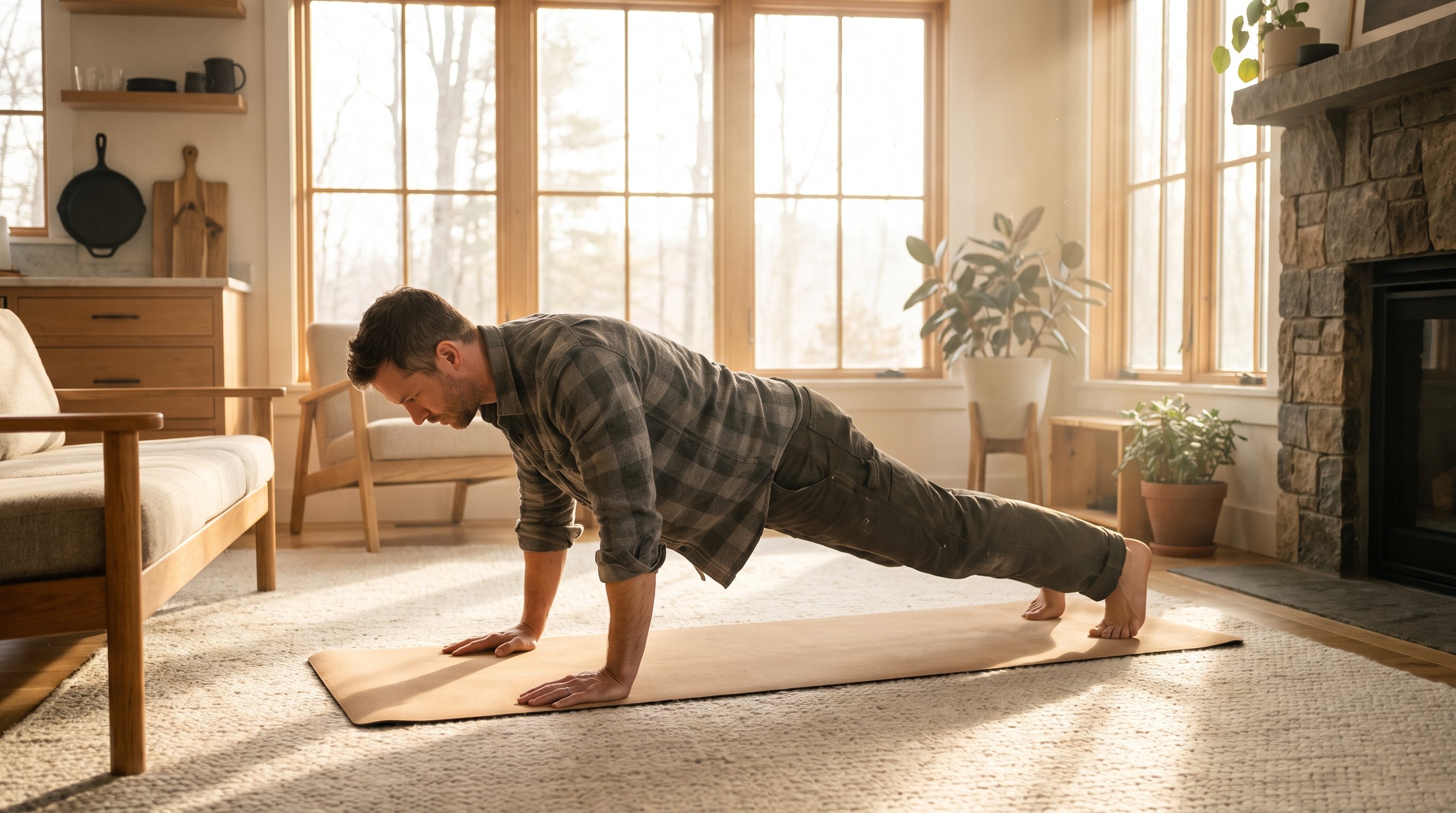
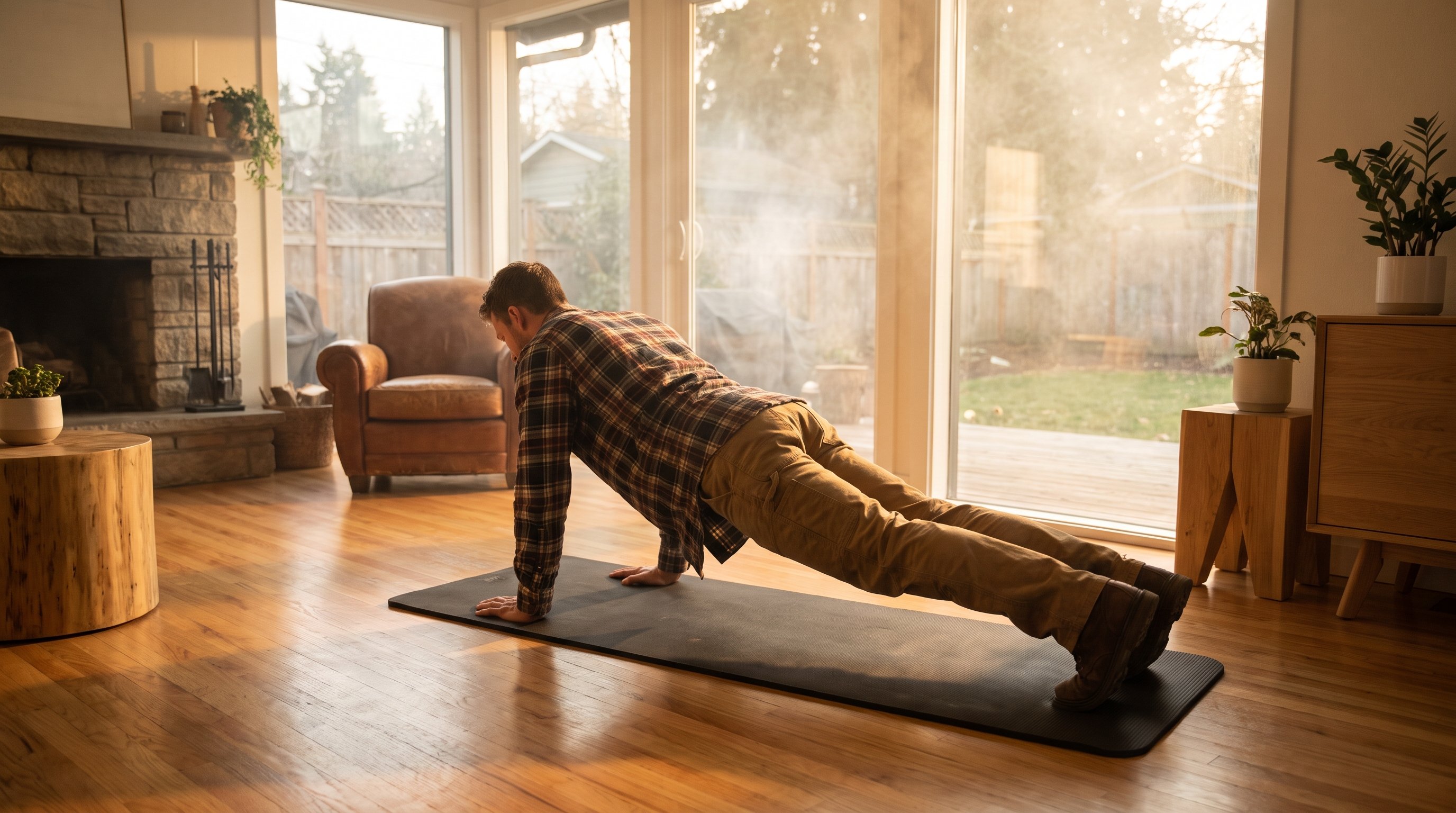
A bodyweight workout uses your own mass as the resistance - push ups, squats, lunges, planks - and it works because muscle responds to load, not to where that load came from.
The mechanism is simple: move a muscle against resistance often enough and it adapts by getting stronger, and your own body weight is resistance that scales with you from day one to year three.
This guide covers whether bodyweight training actually works, how much you need, what stalls progress, and what the first month realistically looks like.
Does a Bodyweight Workout Actually Work?
Strength training works through a basic pattern: stress a muscle beyond what it's used to, let it recover, and it adapts by building capacity.
A push up loads your chest, shoulders and triceps as resistance that scales with your own body weight, and a squat loads your legs with comparable load - that's real resistance, not a placeholder for real training.
The honest arithmetic: if you do three sets of ten push ups three times a week, that's 90 reps of resistance work weekly, and 90 reps repeated for a month is 360 - a number your muscles have to respond to somehow.
Where it has limits is the same place any single method has limits - movement alone, without attention to what you eat, moves slower than movement paired with a food plan that supports it.
Why This Beats the Harder Alternative
The hardest workout in the world does nothing if it happens once a month.
A bodyweight workout removes the two biggest excuses - no gym membership, no equipment to load into a car - which means the number of sessions you actually complete tends to be higher than with a plan that depends on a location.

Adherence is the real variable that decides outcomes: four short sessions a week for two months beats one brutal session a week for the same period, because 32 total sessions will always add up to more stimulus than 8.
Nobody quits a plan they can do in their bedroom in five minutes before a shower - they quit the ones that need a car, a card swipe and a parking space first.
The Quantity Question: How Much, How Many, How Often
There's no single right number, but there is a floor worth knowing: fewer than two sessions a week rarely gives a muscle enough repeated stimulus to adapt before the effect fades.
Above that floor, more sessions generally beat fewer, up to the point where recovery starts to suffer - which for most beginners is somewhere past five or six short sessions a week.
Find Your Own Number
Start from what you can repeat without dreading it, then add a rep or a set only once the current amount feels easy - the goal is a number you'll still be doing in month three, not the biggest number you can survive once.
| Stage | Frequency | Session Length |
|---|---|---|
Just starting | 2-3 sessions/week | 5-10 minutes |
Building habit | 3-4 sessions/week | 10-15 minutes |
Comfortable | 4-5 sessions/week | 15-20 minutes |
Established | 5-6 sessions/week | 20-30 minutes |
The Practical Question: How Do You Actually Fit This In?
Knowing the numbers is one thing - building a routine you'll open on a tired Tuesday is another.
The practical fix is removing decisions: a plan that's already built for your level, that tells you what to do today without you having to think about it.
A tailored calisthenics plan alongside step, water and weight tracking in one place removes the daily friction of deciding what to do, so the question becomes 'did I open the app' rather than 'what should I even do today'.
Pairing that with a meal plan built around food you already like closes the gap between moving more and actually changing shape over time.
Bodyweight vs Weights: The Decision You're Actually Weighing
Most people aren't choosing between good and bad - they're choosing between two things that both work, under different constraints.
Here's how the two stack up on the factors that actually decide whether you stick with it.
| Factor | Bodyweight | Weights |
|---|---|---|
Equipment needed | None | Dumbbells or gym |
Where you can train | Anywhere | Gym or home rack |
Cost to start | Free | Membership or gear |
Progression method | Harder variations | Add more weight |
Time to start today | Immediate | Needs setup |
The Forbidden Promise, Answered Honestly
No workout, bodyweight or otherwise, burns fat from one specific spot - not the stomach, not the arms, nowhere.
The body decides where it draws energy from based on its own patterns, not on which muscle you just trained, so targeted exercises tone the muscle underneath without controlling what sits above it.
There's also no overnight version of this - change happens through repeated sessions over weeks, not through one hard workout.
The real answer is unglamorous: consistent full-body training, done often enough, changes strength and shape over time - and that's genuinely good enough.
Levers That Change the Result
Some choices move the needle more than others - here's what matters most, in order.
What Actually Moves the Needle
- Sessions completed per month - this beats how hard any single session felt, because adaptation comes from repetition, not from one heroic effort.
- What you eat around training - movement alone is slow, and pairing sessions with food that supports recovery speeds up the whole process.
- Sleep and basic recovery - muscle adapts during rest, not during the workout itself, so skipping recovery undercuts every session you did complete.
How Long Until You See Results?
This is where most people quit - somewhere in the stretch where effort feels constant and the mirror hasn't caught up yet.
Strength gains from repeated practice tend to show up before visible shape changes do, simply because the nervous system adapts faster than tissue does.

Rather than fixing a date, treat the early weeks as data collection - are you completing sessions, are reps feeling more controlled - and let the calendar handle the rest.
Your First Four Weeks
The order of what you focus on matters more than hitting a perfect number in week one.
| Week | Focus | Target |
|---|---|---|
Week 1 | Learn the movements | 2-3 short sessions |
Week 2 | Build the habit | 3-4 sessions |
Week 3 | Add reps or sets | 3-4 sessions |
Week 4 | Review and adjust | 4-5 sessions |
What Stalls Progress
Starting Too Hard, Too Fast
A session so tough it puts you off the next one costs more than it gives - scale it back to something you'd actually repeat tomorrow.
Skipping the Food Side Entirely
Training without any attention to what you eat slows the whole process down - even small changes around meals speed up what the workouts are already doing.
Chasing a Number Instead of a Habit
Fixating on one big session instead of a repeatable pattern leads to burnout - shift the goal to sessions completed per month, not intensity per session.
No Way to See the Pattern
Without tracking, it's easy to think you've trained four times when it was really two - a simple log or tracker closes that gap fast.
Treating Rest Days As Failure
Skipping recovery to squeeze in extra sessions backfires, because adaptation happens in the rest between sessions, not just in the sessions themselves.
Why Calistway Works for This
Everything above points to the same conclusion: the workout that gets done the most wins, and the food that supports it matters as much as the reps.
Calistway builds a tailored calisthenics plan around your level, adds a meal plan with over 1000 recipes so eating well doesn't need extra research, and keeps steps, water and weight in one place so the pattern is visible instead of guessed at.
Challenges built into the plan give you a reason to open it on the days motivation runs low, and guides on nutrition and habits fill in the gaps a workout alone can't cover.
Final Thoughts
A bodyweight workout gives you everything you need to get stronger - no membership, no equipment, no excuse about location.
Pick a number of sessions you can actually repeat, pair it with a meal plan that supports it, and let Calistway handle the planning so the only decision left each day is whether to press start.
FAQ
Yes - your own body weight is real resistance, and harder variations of the same movement replace adding a dumbbell as you get stronger.
Not if you progress the movement - a push up becomes a decline push up, a squat becomes a single-leg squat, and the difficulty scales with you indefinitely.
A short session done consistently beats a long one done rarely, and even five to ten minutes a few times a week adds up over a month.
Losing track of whether they're actually training often enough is the biggest reason - a tracking tool with tailored planning exists specifically to keep that visible instead of guessed at.
Share this post