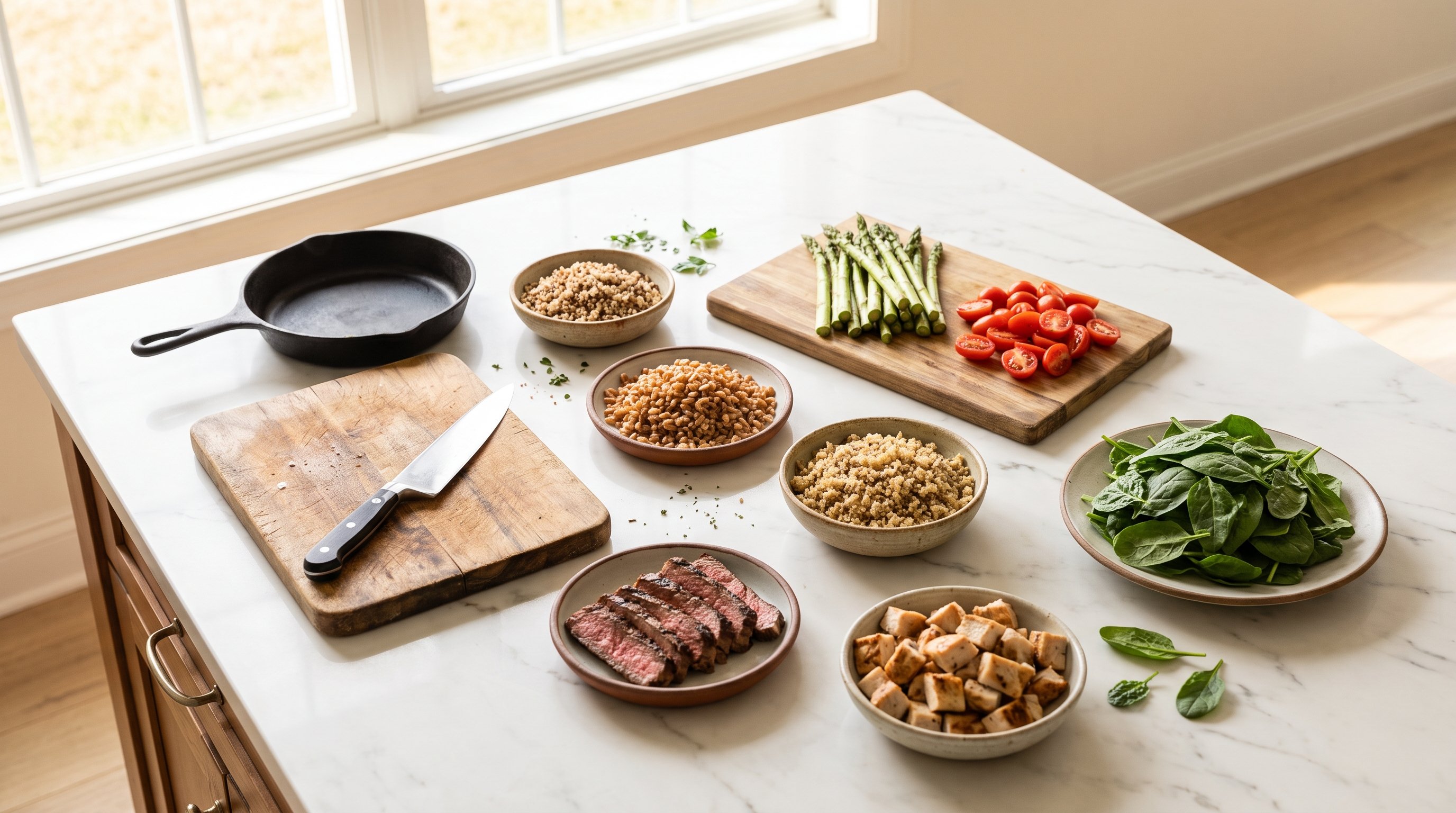
Meal Plan for Bodyweight Athletes: Why Winging It Fails
By:Author:Calistway Editorial
Updated on:October 16, 2026

- Does a Meal Plan for Bodyweight Athletes Actually Work?
- Why This Beats the Harder Alternative
- The Quantity Question: How Much Should a Bodyweight Athlete Eat?
- The Practical Question: What Does This Look Like on a Real Day?
- Comparison: Structured Meal Plan Versus Winging It
- The Forbidden Promise, Answered Honestly
- Levers That Change the Result
- How Long Until You See Results?
- Your First Four Weeks
- What Stalls Progress
- Why Calistway Works for This
- Final Thoughts
A bodyweight athlete moving their own mass through push-ups, dips and pull-ups still needs fuel like any other athlete - the difference is timing and consistency, not some special formula.
Calisthenics uses muscle the same way any resistance training does: tension breaks down fibres, food and rest rebuild them stronger. Skip the food part and the training plateaus no matter how hard the sessions get.
This guide covers how much to eat, how the numbers work, what stalls progress, and how a meal plan for bodyweight athletes fits into a week that also includes a job, sleep and everything else.
Does a Meal Plan for Bodyweight Athletes Actually Work?
The mechanism is simple: bodyweight training creates a demand for protein and energy, and eating to meet that demand is what lets the muscle repair and the body composition shift over time.
Here is the honest arithmetic. If someone needs roughly 2,000 calories a day to maintain their weight and trains hard enough to burn an extra 300 through a calisthenics session, eating back only 100 of those leaves a 200 calorie gap that day.
Do that five days a week and the weekly gap is 1,000 calories - not from a magic food, just from the eating not matching the output.
None of this is about eating less to force a result faster. It is about eating in a way that matches what the training is asking the body to do, day after day.
Why This Beats the Harder Alternative
The harder alternative is a strict, complicated diet plan that demands weighing every gram and cutting out entire food groups.
That kind of plan might look precise on paper, but precision nobody can sustain for more than a few weeks is not actually precise - it just fails later instead of sooner.

A meal plan built around food that is easy to repeat, using ingredients already in the kitchen, gets eaten on a Tuesday night after a long day the same way it gets eaten on a Sunday morning.
Adherence is the whole game. A simple meal pattern followed most days beats a perfect meal pattern followed for one week and then abandoned.
The Quantity Question: How Much Should a Bodyweight Athlete Eat?
There is no single number that fits every bodyweight athlete, because body size, training frequency and goals all change the target.
A useful starting frame is protein first, since bodyweight training relies on repeated muscle tension and protein is the raw material for repairing it.
Find Your Own Number
Start with a rough protein target based on bodyweight, then adjust total calories up or down depending on whether the goal is building strength, losing weight, or holding steady.
The table below is a starting point to test for a week or two, not a rule to follow forever.
| Goal | Protein Target | Calories |
|---|---|---|
Lose weight | 1.6-2g per kg | Slight deficit |
Build strength | 1.8-2.2g per kg | Slight surplus |
Maintain | 1.6g per kg | Matches output |
Adjust weekly based on how training feels and whether the scale or the mirror is moving in the intended direction.
The Practical Question: What Does This Look Like on a Real Day?
In practice, this means three or four meals built around a protein source, a carbohydrate source and vegetables, repeated with small variations across the week rather than reinvented daily.
The hard part is not knowing what to eat - it is knowing how much, and doing it on a Wednesday when nobody is watching.
This is where a meal plan built around food you already like, with recipes that do not demand a culinary course to follow, makes the difference between a good intention and a repeated habit.
A tailored meal plan approach pairs meal guidance with the workout side, so the eating and the training are pulling toward the same goal instead of working against each other.
Comparison: Structured Meal Plan Versus Winging It
Most people weighing up a meal plan for bodyweight athletes are really choosing between two paths: some structure, or none at all.
| Factor | Structured Plan | Winging It |
|---|---|---|
Consistency | Repeatable most days | Depends on mood |
Protein intake | Tracked toward a target | Often falls short |
Grocery trips | Planned, less waste | Reactive, more waste |
Recovery from training | Supported by intake | Inconsistent |
Time to decide meals | Lower, decided ahead | Higher, daily decisions |
Neither path guarantees a result, but one of them removes a decision that has to be made three times a day.
The Forbidden Promise, Answered Honestly
No meal plan, however well built, can target fat loss in one specific area of the body - not the stomach, not the arms, nowhere.
The body draws on stored energy from wherever it decides to, influenced by genetics and factors nobody can dial in through diet alone.
There is also no overnight version of this. Eating and training consistently changes the body over time, not over a weekend, and anyone promising otherwise is not being straight with you.
The real answer is unglamorous: eat to match the training, do it repeatedly, and let the body composition follow at its own pace.
Levers That Change the Result
Some choices move the needle more than others for a meal plan for bodyweight athletes.
Levers Worth Pulling First
- Protein at every meal - this is the single biggest lever, since bodyweight training depends on it for repair and it is the nutrient most people fall short on.
- Meal timing around training - eating a proper meal within a few hours of a session helps recovery keep pace with the demand placed on the muscles.
- Repeating meals instead of reinventing them - a short rotation of easy meals is far easier to sustain than a new recipe every night.
How Long Until You See Results?
This is where most people quit - not because the plan failed, but because they expected to see a difference before enough repetitions had happened.
Strength in bodyweight moves like push-ups and pull-ups tends to show up before visible body composition change does, simply because the nervous system adapts to a movement pattern quickly.

Visible change takes longer and depends on how consistently the eating side matched the training side, week after week.
Staying vague on a timeline is not a dodge - it is honest, because the variables are different for every person and every week of consistency compounds a little more.
Your First Four Weeks
The order of these steps matters more than getting every number exact in week one.
| Week | Focus |
|---|---|
Week 1 | Track what you already eat |
Week 2 | Add protein to every meal |
Week 3 | Match meals to training days |
Week 4 | Adjust portions based on progress |
By week four there should be enough of a pattern to see what is working and what needs a small tweak, not a full restart.
What Stalls Progress
Eating the Same Regardless of Training Load
A rest day and a heavy training day are not the same day nutritionally - adjust portions slightly based on how much the body moved that day.
Skipping Meals After a Session
Waiting too long after training to eat properly delays recovery - fix it by having something planned before the session ends, not after hunger hits.
Chasing a Strict Plan for a Week, Then Abandoning It
A rigid plan that gets dropped after seven days is worse than a loose plan followed for months - loosen the rules until it is repeatable.
Ignoring Protein While Counting Calories
Hitting a calorie number while eating too little protein still slows recovery - fix the protein first, then adjust the rest around it.
Treating the Scale As the Only Signal
Weight can hold steady while strength and shape are changing - track pull-up or push-up numbers alongside body weight to see the full picture.
Why Calistway Works for This
Calistway pairs a tailored calisthenics workout plan with a meal plan built from over 1,000 easy-to-follow recipes, so the eating side of this guide has somewhere concrete to live.
It also keeps step counts, water intake, weight and fasting windows in one place, plus challenges and metabolism-focused guidance, so consistency has a system behind it instead of relying on memory alone.
Final Thoughts
A meal plan for bodyweight athletes does not need to be complicated - it needs to match the training, hit protein consistently, and be repeatable on an ordinary Tuesday.
Start with one change this week, whether that is tracking meals or adding protein to breakfast, and let Calistway handle the structure around it if a tailored plan sounds useful.
FAQ
Anyone doing regular resistance training, bodyweight or otherwise, benefits from a protein intake that supports muscle repair rather than a bare-minimum amount. A rough target of 1.6 to 2 grams per kilogram of bodyweight is a reasonable starting point to test.
No, food provides the raw material but the training is what signals the body to use it for muscle repair. Eating well without training leaves the demand side of the equation empty.
Repeating a small rotation of simple meals removes the daily decision and cuts the cooking time down since the same ingredients get reused. Batch preparing two or three meals at once solves most of the time problem.
Usually because the plan was too strict to repeat on a busy day, or because results did not show up as fast as expected. A tailored meal plan with tracking tools is built to keep the structure simple enough to stick with past that early drop-off point.
Share this post